· 5 min read
Don’t wait for the perfect running shoes – AI transformation is a leadership task

Leading My Business
I recently watched the TEDx talk by Florian Bankoley (external link, opens in a new tab) looked at (including one LinkedIn post (external link, opens in a new tab) (done) – and one image from his talk has stayed with me ever since: If you wait until you have the perfect running shoes before you start training for a marathon, you won’t get any closer to your goal. Whilst you’re waiting, your neighbour has long since been training every day. On the day of the competition, it isn’t the equipment that makes the difference – it’s who has adapted.
For me, this image perfectly captures the essence of what is currently happening with AI in businesses.
The bottleneck has shifted
Many of us still treat AI tools as what productivity tools have always been: useful, impressive – but ultimately just tools that you layer on top of existing structures. I used to think exactly the same way for a long time.
But the real bottleneck is today no longer in service. It lies in our organisational design. We are integrating AI into structures that were designed for a completely different era:
- Organisational charts designed for stability rather than adaptability
- Processes in which decisions must pass through fixed approval stages
- Corporate cultures in which knowledge is synonymous with status
The result is a paradox that I know only too well from my own experience: we have increasingly intelligent tools – and yet we continue to work within outdated structures. Our systems are getting faster. Our decisions are not. We have more intelligence at our disposal, but not necessarily more clarity.
Why hierarchy came about in the first place
One thought from the talk that really stuck with me: hierarchy was never primarily a status symbol. It was a response to complexity. As long as information was hard to come by and expertise was concentrated in the hands of a few, it made sense to refer decisions upwards and issue instructions downwards. That wasn’t bureaucracy for bureaucracy’s sake – it was the logical solution to a real problem.
However, the problem is currently undergoing a fundamental change. As AI helps more and more people to make sense of complexity, weigh up options and carry out processes, The source of authority is also shifting. Leadership no longer stems from consolidating all information – but from enabling better answers to be found more quickly, without losing coherence or accountability.
Three changes the management must go along with today
From the discussion and my own experience within a large, technically complex corporate environment, I have identified three shifts that I use as a guide:
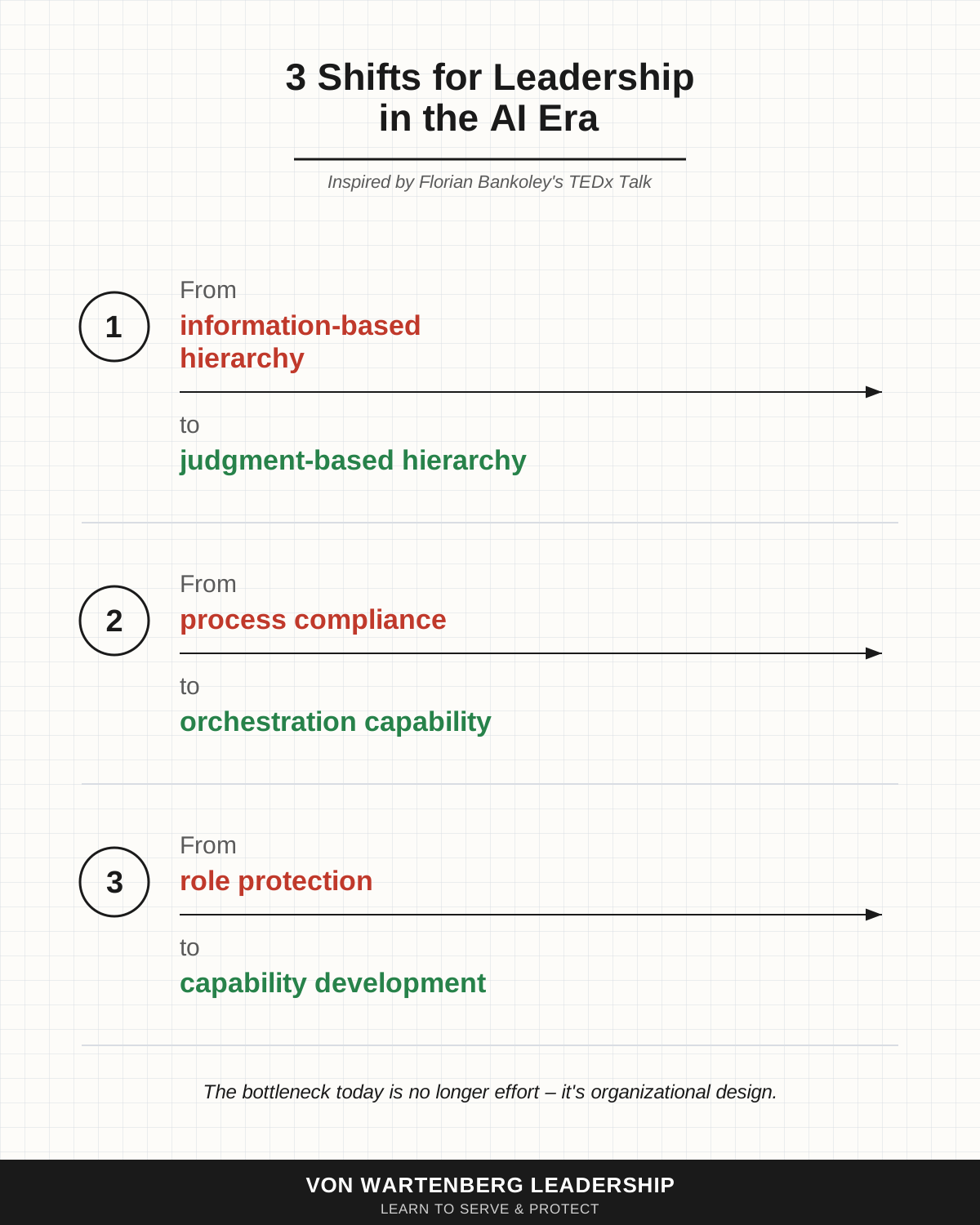
1. From an information-based hierarchy to a judgement-based hierarchy. When information becomes available to everyone, mere factual knowledge loses its value. What counts is the ability to identify the right question, to deal with ambiguity and to take responsibility for the results.
2. From process compliance to orchestration capability. It is no longer simply a matter of people following the process correctly. It is about whether people, AI and systems work together seamlessly throughout the entire value chain – including the question of when to trust AI, when to question it and when to intervene.
3. From role protection to skills development. The relevant question is not which tasks will remain unchanged – there will be surprisingly few of them. The relevant question is: Which human skills become more valuable the more AI helps us deal with complexity? Good judgement. Integrity. Trust. These are the things that only people can build.
Waiting is not caution – it is a strategic illusion
The point that made me think the most was this: in large organisations, hesitation often feels like prudence. We tell ourselves that we’d rather wait until the technology is more mature, until the market has sorted itself out, until standards have been established. That sounds sensible.
But it isn’t. It’s the marathon runner who’s waiting for the latest trainers, even though he could have been training long ago. On the day of the competition, it is not the equipment that determines how far behind you are – but rather the Adaptability.
My assessment
For me, this confirms something I’ve been noticing more and more in my own leadership work: AI transformation is not an IT issue. It is a matter of leadership and organisation. The key question is not ‘How do we use AI?’, but rather: How do we need to reshape leadership and organisation so that people and AI can realise their full potential together?
For me, leadership in the future means, in concrete terms:
- Enabling decisions to be made where the knowledge actually lies
- Establishing a framework rather than micromanaging every step
- Orchestrating collaboration rather than managing hierarchies
- Providing guidance, precisely because information is available to everyone
I myself still have a great deal of work to do in this area. Thanks to Florian Bankoley for giving me food for thought – you can find his TEDx talk here (external link, opens in a new tab).
Clicking “Load video” establishes a connection to YouTube (in privacy-friendly mode). Data may be transmitted to the provider - see our privacy policy.
The future belongs to organisations that have the courage to rethink their structure and their approach to leadership – before the old model catches up with them.
Do you have any thoughts or comments? I’d love to hear them. Please head over to the LinkendIn Post (external link, opens in a new tab). Or drop me a message via the contact page (external link, opens in a new tab).
I’d be delighted to discuss these topics with you.
Dr. Peter von Wartenberg (08.26)
VON WARTENBERG LEADERSHIP – Learn to Serve & Protect