· 7 min read
The Carrot Fallacy: Why you should stop trying to motivate your team
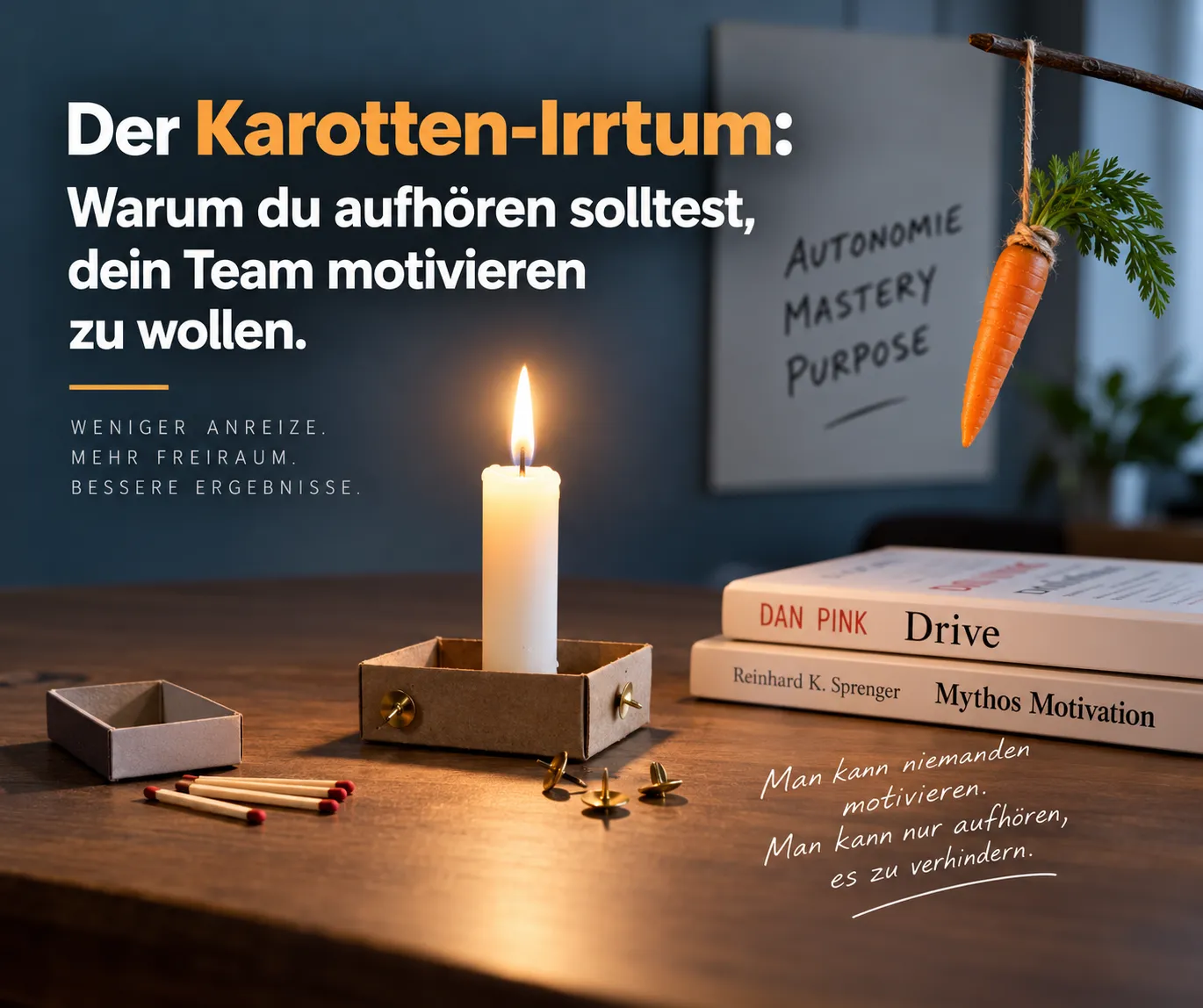
I know: "And coming from PvW. I always thought..."
This post provides a more in-depth foundation for my ‘Motivation to Start the Week (external link, opens in a new tab)’ post – that one is short and sweet, whereas here we’re getting to the root of the matter.
Imagine, I’ll give you a candle, a box of thumbtacks and a few matches. Your task: attach the candle to the wall so that no wax drips onto the table.
It sounds trivial. But it isn’t. That’s the the so-called ‘candle problem’, a Experiment, which the psychologist Karl Duncker (external link, opens in a new tab) developed as early as 1945. Most people take five to ten minutes to find the solution: Empty the thumbtack box, staple it to the wall to form a platform, and place the candle on top.
The trick lies in seeing the box not just as a container, but as a potential tool – psychologists call this Overcoming functional fixation.
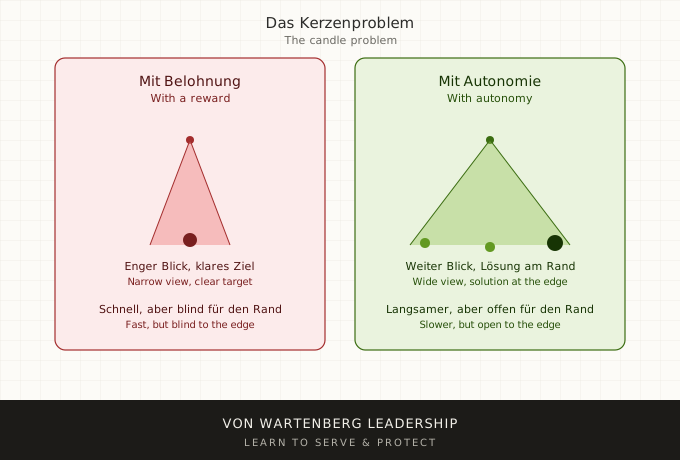
Interesting it will happen when a scientist called Sam Glucksberg (external link, opens in a new tab) brings money into play. A group is given the task without any reward, just for measuring time. A second group You pay for speed: up to 20 dollars for the quickest solution. What’s happening?
On average, the paid group needs three and a half minutes longer.
For money. For almost 40 years, this has been one of the most robust – and most widely ignored – findings in behavioural research.
Why rewards are counterproductive in this context
The reason is simple, once you’ve seen it: Rewards narrow one’s focus. They’re brilliant when the solution is straightforward and the rules are clear.
That is precisely why the result is reversed, as soon as you alter the same task slightly – the thumbtacks are already lying loose next to the empty box. Now it’s purely a matter of hard work, and the paid group wins by a landslide.
But when it comes to the a real problem with candles is the Solution: not straight ahead. It’s right at the edge of your field of vision. And a bonus ensures that you no longer look in that exact spot.
That is the essence of a TED Talk by Dan Pink (external link, opens in a new tab), which I came across a few years ago and which has been echoing in my mind ever since – precisely because it with the familiar to many companies Performance Bonus Scheme so causes uncomfortable chafing.
He argues: ‘White-collar work’ has shifted. Anything that is rule-based – certain types of bookkeeping, certain types of analysis, certain types of code – can now be automated or outsourced cost-effectively. What remains is the creative, conceptual work. And any team working on a task like this, is working on his own version of the candle problem: Unclear rules, no obvious solution.
For this sort of work Do the carrot and stick approach simply work? no longer reliable. Pink’s alternative: Autonomy, Mastery, Purpose – the ability to take control of one’s own actions, to improve at something that matters, and to be part of something bigger.
Germany’s tougher response
What really drew me in about this topic was that there is a German voice, which reaches the same conclusion, but more forcefully. Reinhard K. Sprenger (external link, opens in a new tab), a consultant to almost all DAX-listed companies for over 30 years, considers the whole concept of ‘motivation’ to be overrated – not because it doesn’t matter, but because they only one of three covers performance dimensions.
For him, performance arises from the interplay between Willingness to work hard, Performance and Performance capability. And, of all things, it is precisely this willingness that is at the heart of the whole Motivational circus he considers this to be the least important of the three. Talent and the right conditions are more important.
In his classic work The Myth of Motivation he distinguishes between Motivation and Motivation. Motivation comes from within; it is self-direction. Motivation comes from outside; it is external control – and therefore always involves a degree of mistrust. Anyone who needs to be motivated is assumed not to want to do so of their own accord. And, in any case, Sprenger cannot provide meaning as a service: It is called ‘giving meaning’, not ‘taking meaning’ – Everyone has to assign them to themselves; they cannot be imposed.
This is most evident when it comes to the topic of “Nudging” (see below). The bratwurst as an incentive to get vaccinated, the fruit basket designed to nudge people towards healthy choices – for Sprenger, this is just the the friendliest version of the same principle as a reward and a threat: Do this, and you’ll get that.
His accusation: This reduces people to Stimulus-response machines. And when it comes to workplace health schemes, he goes one step further – He would even recommend that companies scrap their yoga classes. As far as he is concerned, responsibility for one’s health is a private matter, not a corporate one. His philosophy on the matter, put succinctly in a way that defies translation: duty is duty, and schnapps is schnapps.
The so-called the five Bs – Reward, praise, bribe, threaten, punish – for him, they undermine precisely the attitude they are actually meant to foster. His point, put in business terms: "We have neither an educational remit nor a therapy contract within the company." It is not the role of leadership to motivate someone. It is the role of leadership not to undermine motivation.
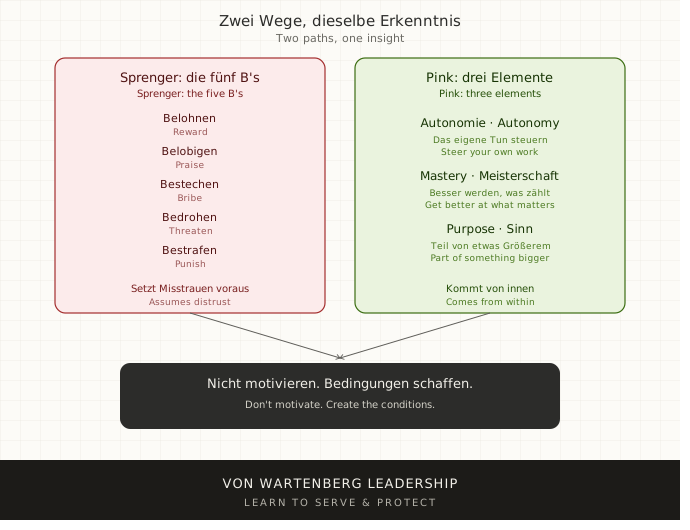
An American behavioural economist with candles and dollar notes, a German philosopher with a sharp critique of language – Two completely different paths, but they have both led to the same point.
However, the figures don’t quite add up
And I don’t want to keep that to myself. Pink Purpose is marketed almost like a recipe: give people a greater sense of purpose, and motivation will follow. Sprenger would disagree with this. For him, a sense of purpose cannot be provided as a ready-made offering – that would be taking away meaning rather than giving it. Leadership can create the right conditions, but it never provides the meaning itself. In practice, this makes little difference; both arrive at the same conclusion: Leadership does not create meaning, At most, she cannot prevent it. But it’s worth making that distinction before marketing ‘Purpose’ as a leadership tool that can simply be put into practice.
What this means for your leadership
The practical difference is not ‘more freedom instead of a bonus’. It is a different fundamental question. Not: How do I motivate my team? Rather: In what ways am I currently getting in my team’s way?
Three questions I’ve been asking myself every now and then ever since:
- Autonomy: In which situations am I currently making a decision that someone on my team could – and should – actually be making?
- Mastery: In which situations does a member of my team end up being given a task that’s below their level of ability because ‘it’s quicker if I just do it myself’?
- Purpose: Can everyone on my team explain in a single sentence what their work this week is good for – beyond the figures in the Excel spreadsheet?
That is problematic because it places the onus on management rather than on staff. But that is precisely the point: You can’t motivate anyone. You can only stop getting in their way.
Do you have any suggestions or comments? We’d love to hear them. Please go to the LinkedIn post (external link, opens in a new tab):
Or get in touch via the Contact page (external link, opens in a new tab).
I’d be delighted to discuss these topics.
Dr Peter von Wartenberg (21 August)
Videos by Dan Pink
Clicking “Load video” establishes a connection to YouTube (in privacy-friendly mode). Data may be transmitted to the provider - see our privacy policy.
Clicking “Load video” establishes a connection to YouTube (in privacy-friendly mode). Data may be transmitted to the provider - see our privacy policy.
Reinhard K. Sprenger, The Myth of Motivation (GABAL Verlag)
and articles: "Motivation is massively overrated" (external link, opens in a new tab)
Nudging translates as ‘nudge’ or ‘prompt’ and refers to a method of subtly influencing people’s behaviour through small changes to their environment, without resorting to prohibitions, rules or financial incentives.